About ADU Services Remodeling Projects Blog Areas Contact Schedule Consultation
Blog

KITCHEN COUNTERTOPS: WHAT WE ACTUALLY INSTALL IN BAY AREA HOMES (AND WHY)

June 2026 · 9 min read · Kitchen Remodeling

If you ask us what countertop most Bay Area kitchens get on a Mendez project, the answer is quartz. Not because quartz is exotic. Not because it's a luxury statement. Because at the intersection of stain resistance, durability, install cost, and 10-year ownership cost, engineered quartz is the material most Peninsula and Tri-Valley homeowners end up picking once they've seen the trade-offs.

This post lays out what kitchen countertops actually do in a working Bay Area kitchen, where each material wins and where it fails, what the install perspective is on materials Instagram makes look amazing, and the practical reason natural stone work tends to land with a different kind of contractor than the kitchen-remodel-first crew.

Spec Your Kitchen Counters
Bay Area kitchen countertop installation in progress with quartz slab and lower cabinets ready for placement
01 - Performance Matrix

THE PERFORMANCE MATRIX THAT ACTUALLY MATTERS

Most countertop articles run a feature comparison chart. We'll do the same, but from the install-perspective rather than the showroom version. Numbers from Consumer Reports testing, stone fabricator association data, and our own field experience.

Engineered quartz delivers excellent stain resistance (non-porous), limited heat tolerance (resin softens above ~300°F), 7.0 Mohs hardness, $50 to $150 per square foot installed, and low 20-year maintenance with no sealing required.

Granite (natural) shows moderate stain resistance (porous, needs sealing), excellent heat tolerance (480°F+), 6.0 to 7.0 Mohs hardness, $50 to $200 per square foot installed, and moderate maintenance (about $150 every 2 years for sealing).

Sintered stone (Dekton and similar) shows perfect stain resistance (zero porosity), excellent heat tolerance, 7.0 to 8.0 Mohs hardness, $50 to $100 per square foot installed, and low maintenance BUT high edge-chip risk.

Natural quartzite runs moderate on stains (porous, acid-prone), excellent on heat, 7.0 Mohs, $90 to $200 per square foot installed, and moderate maintenance with annual sealing. Marble is poor on stains (acid etches even sealed), moderate on heat, 3.0 to 5.0 Mohs, $70 to $250+ per square foot, and high maintenance with regular professional honing. Solid surface (acrylic) is excellent on stains, poor on heat, $50 to $120 per square foot, low maintenance with DIY sandable scratches. Butcher block is poor on stains (oils, water), poor on heat, $35 to $80 per square foot, and high maintenance with regular re-oiling and permanent knife scarring.

Ranges hold for most Bay Area projects but vary with slab selection, edge profile, and seam complexity. A 12-foot-long island in a single slab carries a premium over the same square footage in multiple pieces.
INSTALLED COST PER SQFT
Engineered quartz$50 to $150
Granite$50 to $200
Sintered stone$50 to $100
Natural quartzite$90 to $200
Marble$70 to $250+
Solid surface$50 to $120
02 - Engineered Quartz

WHY QUARTZ WINS FOR MOST BAY AREA KITCHENS

Engineered quartz (about 93 percent quartz crystals bonded with polymer resin) does five things at once that most other materials only do three of.

The non-porous surface means stains from beet juice, red wine, food coloring, and turmeric don't penetrate. Consumer Reports stain testing shows quartz outperforming granite consistently. No sealing is required, ever. Antibacterial as a material property, which matters for a household with kids or for food prep workflows. Hard enough (7.0 Mohs) that everyday knife and pan use doesn't scratch it. And the slab thickness and engineering means it cuts and installs cleanly without the surprise crack risk that natural stone occasionally hides.

The one real weakness is heat. Engineered quartz uses polymer resin as its binder, and the resin softens at temperatures above about 300°F. A cast-iron skillet straight off a hot burner can cause permanent discoloration or micro-cracking right where it sits. Trivets are required, not optional. Most quartz manufacturers void the warranty if direct hot-pan damage shows up.

For most Bay Area households (cooking moderately, entertaining occasionally, not running a restaurant-grade workflow at home), the trivet requirement is a tolerable trade-off for everything quartz delivers on the other dimensions. That's how quartz became the default in Peninsula and Tri-Valley kitchens, and it's the material we spec most often on a Bay Area kitchen remodel.

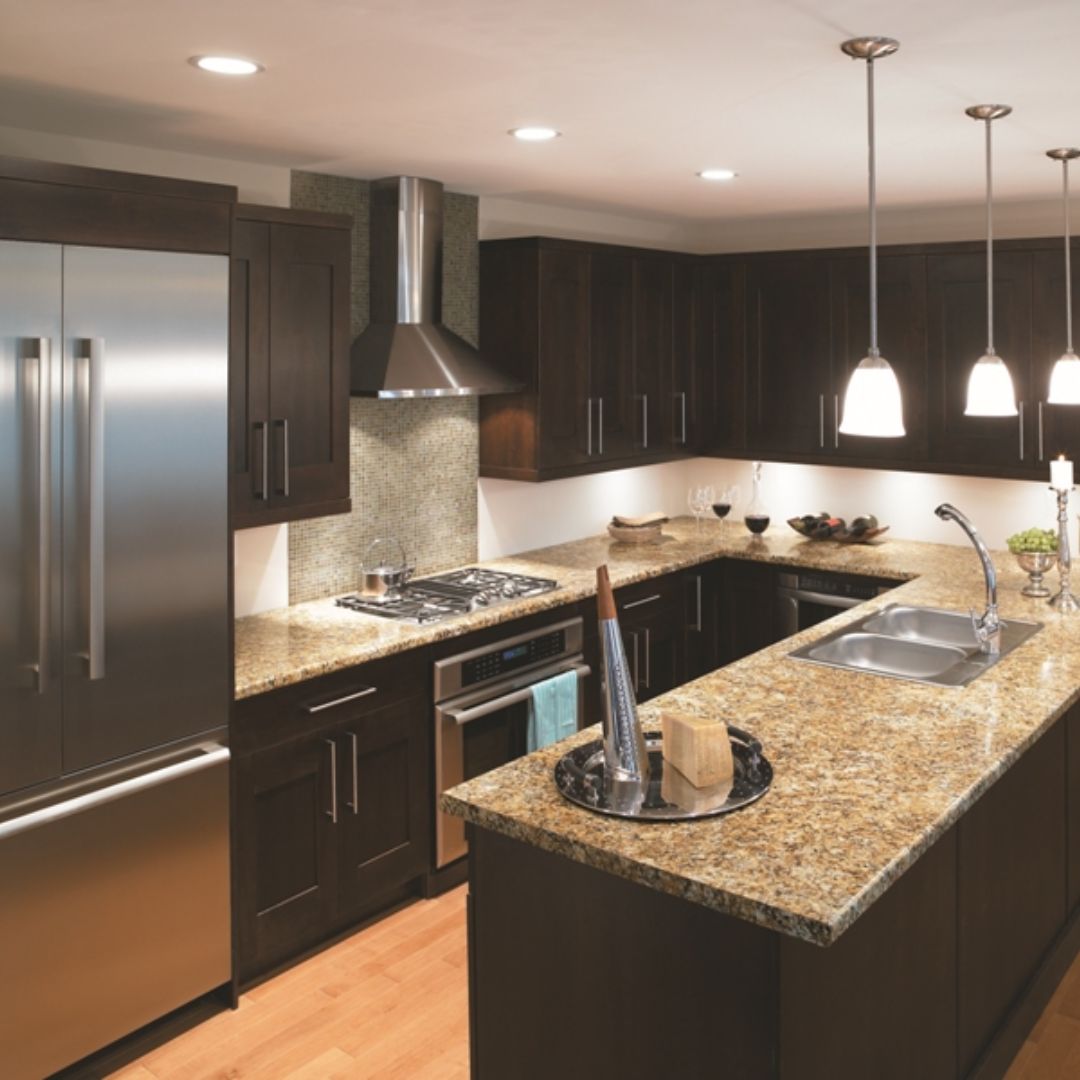
Bay Area kitchen remodel featuring dark cabinets with granite countertops, one of the natural stone options Mendez installs
03 - Granite

WHERE GRANITE STILL EARNS ITS PLACE

Granite is the material a homeowner picks when thermal performance is the priority and the maintenance commitment is acceptable.

Granite handles direct heat (480°F+) without discoloration or cracking. Cast iron skillets, large stockpots straight off the burner, pans of cookies straight out of the oven. Granite absorbs the heat without flinching. For a household that cooks heavily and finds the trivet requirement annoying, granite is the better answer.

The trade-off is maintenance. Natural granite is porous, which means it has to be sealed every one to two years for most types. Failed sealing leads to staining. Over a 20-year ownership window, the cumulative cost of professional sealing adds roughly 20 to 30 percent to the total material cost compared to quartz. Granite also shows more visual variation slab-to-slab, which some homeowners love and some find inconsistent.

For Bay Area kitchens running heavy cooking workflows, especially households of cooks, granite is still a strong choice. We install it regularly when the homeowner has decided thermal performance matters more than zero maintenance.

GRANITE OWNERSHIP PROFILE
Heat tolerance480°F+
Sealing intervalEvery 1 to 2 years
Sealing cost~$150 per cycle
20-yr maint. premium~20-30% vs quartz
Visual variationHigh, slab to slab
Best fitHeavy cooking households
04 - Concerns to Surface

WHAT WE DON'T RECOMMEND LIGHTLY

Three materials show up on showroom floors a lot and we have concerns about each.

Marble as primary kitchen counters. Marble is beautiful. Marble is also calcium carbonate, which reacts chemically with anything acidic. Lemon, vinegar, tomato sauce, white wine. Each one etches the surface and dulls the polish on contact, even on sealed marble. Sealers slow the reaction down; they don't stop it. Italian and French homeowners have lived with marble counters for centuries because they accept the patina that develops over time. American buyers more often photograph the showroom slab and expect it to look that way at year three. Those expectations don't match.

We don't refuse to install marble. We surface this conversation and let the homeowner make the decision. Marble in a butler's pantry, a coffee bar, or a fireplace surround (low-acid zones) is a beautiful application. Marble as the primary work surface in a busy family kitchen is usually a regret-in-three-years material.

Sintered stone (Dekton and similar). The marketing pitch is "perfect in every dimension." The install perspective is more nuanced. Yes, the surface is nearly indestructible. No, the edges aren't. Sintered stone is fused at extreme heat and pressure, which makes it glass-like in structure. A cast-iron skillet dropped or struck against a sintered edge produces a permanent, non-repairable chip. We've seen this happen at year two on installs that were otherwise pristine. If the household has a tendency to set heavy pans down hard, this is the risk to know about up front.

Butcher block. Beautiful, warm, and unforgivingly demanding. Requires regular oiling. Water from sink splashes will swell and warp the wood within months if not sealed compulsively. Knife scarring is permanent. We install it occasionally as an island accent surface, almost never as the primary kitchen counter.

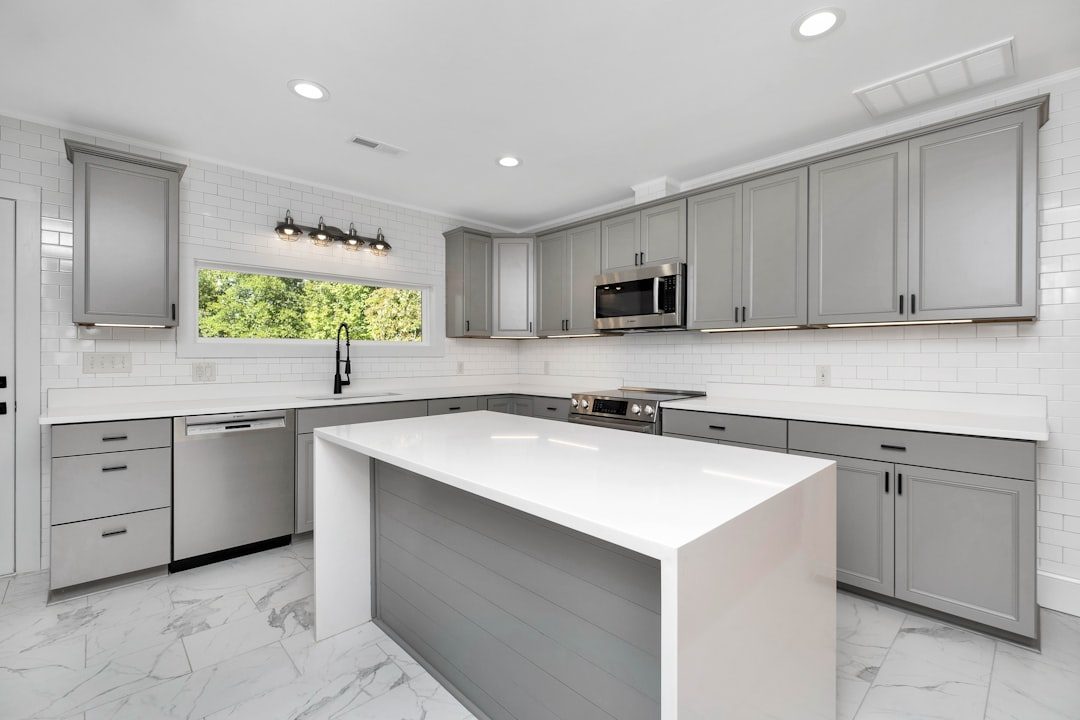
Bay Area kitchen remodel with white cabinets and an engineered quartz island, the most-spec'd combination in Peninsula and Tri-Valley kitchens
05 - Procurement Sequence

THE PROCUREMENT SEQUENCING YOU NEED TO KNOW

The kitchen counter material decision has a procurement implication most homeowners don't see coming. Countertops can't be ordered ahead the way cabinets can.

The actual sequence:

1. Cabinet selection and order locks in (8 to 16 weeks lead time for custom).

2. Appliance package locks in (luxury appliances 4 to 12 weeks lead time).

3. Cabinets get installed and anchored.

4. Countertop fabricator templates the actual cabinet positions.

5. Slab is cut and installed (1 to 3 weeks from template).

Steps 4 and 5 cannot happen until step 3 is complete. So the countertop material decision has to be made during pre-construction (because the slab has to be sourced and ready), but the countertops physically arrive in the kitchen after most of the cabinetry is in. A homeowner who's still picking countertops three weeks into construction is fine; a homeowner who's still picking cabinets at that point is in trouble.

For more on how the full kitchen procurement sequence works, see our kitchen remodel planning post. For the cost ranges by remodel scope, the kitchen remodel cost Bay Area post breaks down what counter materials add to the total. For broader scope work, see our whole house remodel and bathroom remodel pages.

COUNTERTOP LEAD TIMES
Custom cabinets8 to 16 weeks
Luxury appliances4 to 12 weeks
Template to install1 to 3 weeks
Template triggerCabinets anchored
Material decisionPre-construction
Slab sourcingConcurrent with cabs
06 - Scope Statement

A DIRECT NOTE ON THE HIGH-END NATURAL STONE LANE

A direct note on scope. The high-end Bay Area natural stone work (imported Italian marble, rare Brazilian quartzite, bookmatched slabs specified by a kitchen designer for a $400,000+ kitchen) is its own subset of the industry. Those projects tend to be designed by a kitchen designer, supplied by a specialty stone yard, and finished by a fine-finish carpentry crew that specializes in natural stone fabrication.

We do work in that lane, but typically as the fine-finish carpentry subcontractor, not as the lead contractor on the kitchen. The natural-stone-as-statement market and the engineered-quartz-as-default market are different worlds with different supply chains and different client expectations. Most of our kitchen work is in the second world, where quartz solves the homeowner's actual problem better than natural stone solves it.

That's a scope statement, not a sales pitch. If you're planning a kitchen where the primary design statement is a rare natural stone slab specified by a designer, your project is probably a different team than ours. If you're planning a kitchen where you want the counters to be excellent for ten years of daily use without becoming a project unto themselves, that's the kitchen we run.

If you're planning a kitchen remodel and want to talk through which counter material actually fits your household's cooking style, finish budget, and maintenance tolerance, the pre-contract walk-through is where that conversation happens. We come out, look at the kitchen, talk through what you want, and put a real number on each material option so you can make the trade-off cleanly. We don't take deposits.

Schedule Your Kitchen Walk
OUR KITCHEN LANE
Default materialEngineered quartz
Heavy-cook specGranite
Accent surfacesButcher block, marble
Designer stone workSubcontractor role
Walk-throughFree, no deposit
Quote validityReal number per material

For kitchen remodels, countertop installation, and home renovations in the Bay Area, visit https://mendezandsonsinc.com.

Mendez & Son's Construction

39647 Iolani Ct.

Fremont, CA 94538

(408) 849-7340

Read more reviews for our Bay Area kitchen remodeler team on Yelp.